Introduction
A drum pump may look like a simple piece of industrial equipment, but its reliability depends on dozens of engineering and manufacturing decisions. A trusted Drum Pump Manufacturer must consider fluid compatibility, component strength, sealing, motor performance, operating conditions, and ease of maintenance before a pump reaches the factory floor.
This article takes you through the complete journey of an industrial drum pump, from design and material selection to assembly and testing. You will also learn what separates an ordinary pump from a reliable one and what buyers should check before making a purchase.
What Makes a Drum Pump Reliable?
Reliability is not simply about whether a pump starts working when switched on. An industrial pump must perform consistently under real operating conditions.
A reliable drum pump should offer
- Consistent fluid transfer
- Suitable chemical compatibility
- Stable flow performance
- Strong mechanical construction
- Effective sealing
- Easy operation
- Low maintenance requirements
- Safe handling
- Resistance to regular industrial wear
The right combination of these factors helps reduce unexpected downtime and improves productivity.
Reliability Starts With the Application
Before designing a pump, engineers need to understand its intended application.
Important considerations include
- Fluid viscosity
- Chemical properties
- Required flow rate
- Required discharge pressure
- Drum or container size
- Operating temperature
- Duty cycle
- Power availability
- Required hose and connection type
A pump designed for transferring lubricating oil, for example, may require different materials and performance characteristics from one intended for handling aggressive chemicals.
Understanding Drum Pump Design
Good drum pump design begins with a clear understanding of how the equipment will be used.
The pump must move fluid efficiently while maintaining structural integrity throughout operation.
Main Components
A typical industrial drum pump can include
- Pump tube
- Impeller or rotor assembly
- Drive shaft
- Motor or drive unit
- Sealing components
- Couplings
- Discharge connection
- Handle or operating mechanism
- Protective components
Each part contributes to overall performance.
A small weakness in one component can eventually affect the entire pumping system.
Why Pump Geometry Matters
Internal geometry influences how efficiently fluid moves through the pump.
Engineers consider factors such as
- Internal clearances
- Flow path
- Shaft alignment
- Rotating component dimensions
- Pump tube diameter
- Discharge configuration
Poorly controlled dimensions can create vibration, inefficient fluid movement, premature wear, or inconsistent output.
Industrial Drum Pump Manufacturing Process
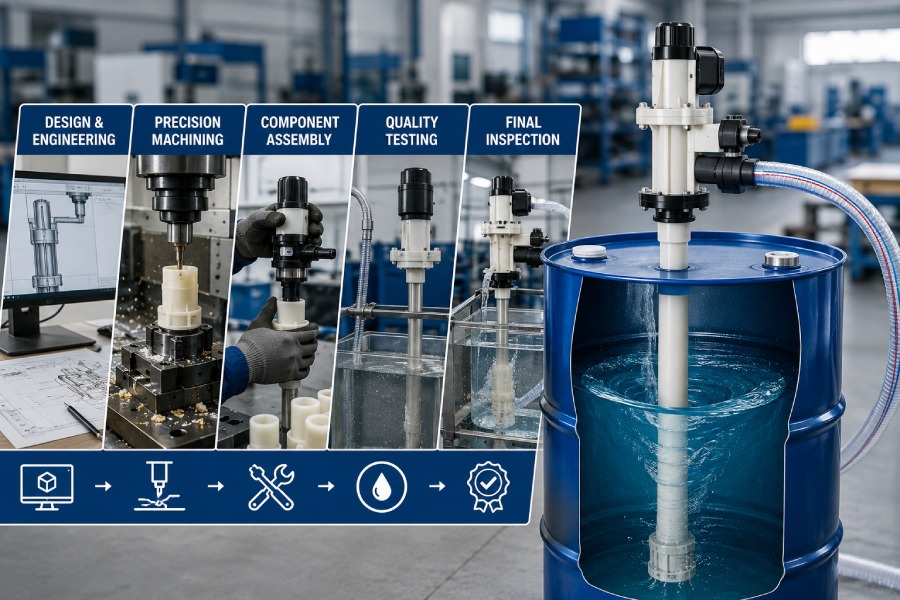
The drum pump manufacturing process involves several stages. Each stage has a specific purpose and quality requirement.
1. Product Design and Engineering
Manufacturing starts with engineering drawings and specifications.
Design teams determine
- Dimensions
- Material requirements
- Component tolerances
- Motor specifications
- Connection sizes
- Expected operating conditions
- Safety requirements
Computer-aided design tools can help engineers evaluate component relationships before production begins.
2. Material Selection
Material selection is one of the most important decisions in industrial pump manufacturing. Different applications can require different construction materials.
Common considerations include
- Corrosion resistance
- Mechanical strength
- Chemical compatibility
- Temperature resistance
- Wear resistance
- Manufacturing practicality
The material should match the fluid being transferred and the expected operating environment.
3. Component Manufacturing
Individual components are produced according to approved specifications.
Depending on the component, production can involve
- Machining
- Cutting
- Forming
- Moulding
- Drilling
- Surface finishing
- Precision fabrication
Dimensional accuracy is important because components must fit together correctly during assembly.
4. Shaft and Rotating Component Preparation
The shaft is particularly important because it transfers mechanical energy from the drive unit to the pumping mechanism.
Manufacturers pay attention to:
- Straightness
- Diameter
- Surface finish
- Alignment
- Dimensional tolerance
Poor alignment can contribute to vibration and accelerated component wear.
5. Sealing and Gasket Installation
Seals prevent unwanted leakage around moving or connected components.
The selected sealing material must be suitable for
- The pumped fluid
- Operating temperature
- Pressure conditions
- Chemical exposure
- Expected service life
A seal that works well with one fluid may not perform equally well with another.
6. Assembly
Once individual components pass inspection, they are assembled.
Assembly typically involves
- Installing the pump tube
- Fitting internal components
- Connecting the shaft
- Installing seals
- Mounting the drive unit
- Checking couplings
- Securing connections
Correct assembly is essential because even accurately manufactured components can perform poorly when incorrectly fitted.
7. Functional Testing
The completed pump is then evaluated to determine whether it performs according to its specifications.
Testing may examine
- Starting performance
- Flow consistency
- Vibration
- Leakage
- Noise
- Motor operation
- Rotation
- Connection integrity
Testing helps identify issues before the equipment reaches the customer.
Materials Used in Drum Pump Construction
Material selection depends heavily on the intended application.
Stainless Steel
Stainless steel is widely valued for its
- Corrosion resistance
- Strength
- Durability
- Long service potential
- Suitability for demanding environments
It can be useful where equipment is exposed to moisture or corrosive fluids.
Polypropylene and Other Engineering Plastics
Engineering plastics can provide useful resistance to certain chemicals while keeping equipment relatively lightweight.
They may be considered for applications where
- Chemical compatibility is important
- Lightweight handling is preferred
- Corrosion resistance is required
However, compatibility should always be evaluated for the specific fluid and operating conditions.
Elastomers and Sealing Materials
Seals and gaskets require careful material selection.
Their performance can affect
- Leakage prevention
- Service life
- Safety
- Maintenance frequency
The correct material depends on the fluid, temperature, pressure, and application.
Key Quality Checks Before Dispatch
Quality control should not be treated as the final step only. It should continue throughout production.
A robust inspection system may include
Dimensional Inspection
Components are checked against engineering specifications.
This helps ensure:
- Correct fit
- Proper alignment
- Consistent assembly
- Repeatable performance
Leakage Inspection
Seals and connections are checked for unwanted leakage.
This is particularly important when the equipment will handle hazardous, corrosive, or valuable fluids.
Performance Testing
The assembled pump may be operated under controlled conditions to assess its performance.
Key observations can include
- Flow behavior
- Motor operation
- Vibration
- Noise
- Starting characteristics
- Overall stability
Visual Inspection
The final inspection can identify
- Surface damage
- Incorrect assembly
- Loose components
- Finishing problems
- Missing parts
Simple visual checks can prevent avoidable problems.
Factors That Affect Pump Performance
Even a well-built pump can perform poorly if it is incorrectly selected or operated.
-
Fluid Properties
Viscosity, temperature, chemical composition, and density can influence pumping performance.
-
Pump Selection
The pump should be matched to the application rather than selected solely by price.
-
Operating Conditions
Continuous operation, frequent starts and stops, extreme temperatures, and demanding environments can affect component life.
-
Maintenance
Routine inspection can help identify problems before they become expensive failures.
Useful maintenance practices include
- Inspecting seals regularly
- Checking connections
- Cleaning suitable components
- Monitoring unusual vibration
- Checking for leakage
- Following manufacturer operating instructions
Pros and Cons of Industrial Drum Pumps
| Advantages | Limitations |
|---|---|
| Convenient fluid transfer | Selection must match the fluid |
| Reduces manual handling | Seals can wear over time |
| Suitable for many industrial applications | Incorrect operation can reduce service life |
| Can improve transfer efficiency | Some fluids require specialized materials |
| Available in different configurations | Regular inspection is still necessary |
The biggest benefit is convenience combined with controlled fluid transfer. However, performance depends on selecting the right configuration for the actual application.
How to Choose the Right Drum Pump
Buying decisions should begin with the application, not the product name.
Check These Factors First
-
Identify the fluid
Know exactly what material will be transferred.
-
Check viscosity
Thicker fluids can require different pumping characteristics.
-
Determine the required flow rate
Consider how quickly the container needs to be emptied or filled.
-
Consider chemical compatibility
Confirm that wetted components can safely handle the fluid.
-
Check the power source
Determine whether the application requires an electric, pneumatic, or other suitable drive configuration.
-
Evaluate operating frequency
A pump used occasionally may have different requirements from equipment operating throughout the working day.
-
Consider maintenance access
Easy inspection and replacement of wear components can reduce downtime.
Why Manufacturing Quality Matters
A dependable pump is the result of many small details working together.
Strong manufacturing practices can provide
- Better component consistency
- More predictable performance
- Improved assembly accuracy
- Reduced leakage risk
- Better durability
- Greater operational confidence
This is why industrial pump manufacturing requires more than simply assembling parts. Engineering, material science, machining, assembly, inspection, and testing all contribute to the finished product.
For manufacturers and industrial buyers, this matters because pump failure can affect more than one piece of equipment. It can interrupt production, increase material wastage, create safety concerns, and raise maintenance costs.
Conclusion
The making of a reliable industrial drum pump is a combination of engineering accuracy, suitable materials, controlled manufacturing, careful assembly, and thorough testing.
The most important lessons are simple
- Start with the application
- Select compatible materials
- Maintain dimensional accuracy
- Build components carefully
- Test the finished assembly
- Follow appropriate maintenance practices
A drum pump should not be judged only by how it looks or how quickly it transfers liquid. Its real value comes from consistent performance, safe operation, durability, and suitability for the job.
FAQ’s
Industrial drum pump manufacturing is the process of designing, producing, assembling, and testing pumps used to transfer liquids from drums and similar containers. It includes material selection, component production, assembly, inspection, and performance testing.
A reliable drum pump should provide consistent fluid transfer, durable construction, suitable material compatibility, effective sealing, stable operation, and practical maintenance requirements. Correct pump selection is equally important.
Drum pump design affects flow efficiency, component alignment, mechanical stability, sealing, handling, and overall service life. A well-planned design helps the pump perform consistently under its intended operating conditions.
Industrial pump manufacturing can improve reliability through controlled dimensions, appropriate materials, accurate assembly, inspection, leakage checks, and functional testing. Consistent production practices help reduce avoidable defects.