Introduction
Industrial fluid handling has changed significantly as manufacturers look for safer, faster, and more consistent ways to move liquids. A Motorized Barrel Pump can help businesses simplify drum handling while reducing the physical effort associated with traditional pumping methods.
Today, industries dealing with chemicals, oils, lubricants, solvents, fuels, and other industrial liquids are increasingly looking for reliable Drum Pumping Solutions that provide better control and efficiency.
The answer comes down to a combination of worker safety, productivity, consistency, contamination control, operating convenience, and long-term cost efficiency.
Why Manual Drum Pumping Is Losing Ground
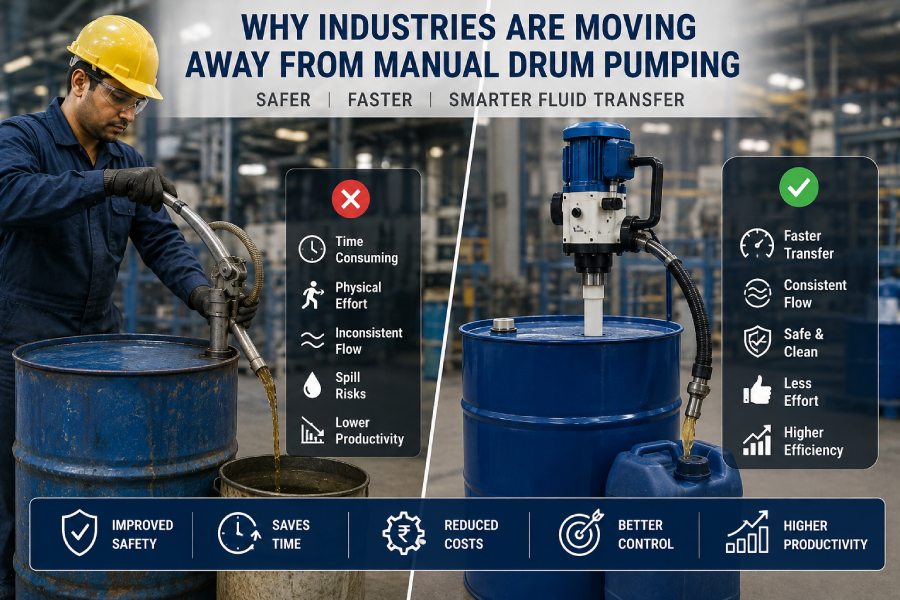
Manual pumping may appear simple, but simplicity does not always mean efficiency. Traditional systems often require an operator to repeatedly turn a handle, operate a lever, or manually control the pumping mechanism. When only a small quantity of liquid needs to be transferred occasionally, this may not be a major concern.
The situation changes when pumping becomes part of everyday production.
Common challenges include
- Repetitive physical effort
- Slower liquid transfer
- Operator fatigue
- Inconsistent flow rates
- Greater risk of spills
- Difficult handling of high-viscosity fluids
- Limited control over dispensing
- Increased labor involvement
- Higher risk during frequent drum handling
For a business moving several drums every day, these small inefficiencies can add up quickly. What starts as a simple manual task can become a bottleneck in an otherwise efficient production line.
What Makes Manual Drum Pumping Challenging?
The biggest issue is not necessarily that manual pumps do not work. They do.
The problem is that modern industrial operations often demand more than simply moving liquid from point A to point B.
1. Physical effort
Repeated pumping can place unnecessary strain on workers, particularly when large quantities must be transferred throughout the day. This becomes more noticeable when the liquid is viscous or when the drum requires frequent emptying.
2. Variable transfer speed
Manual operation depends heavily on the person using the pump. One operator may pump faster than another. Fatigue can also affect performance during longer tasks. As a result, transfer rates may vary.
3. Spill risks
Manual handling involves more direct interaction with drums, containers, hoses, and dispensing points. A poorly controlled transfer can result in splashing or spills. Apart from material loss, spills can create housekeeping and workplace safety concerns.
4. Limited process control
Modern manufacturing often relies on predictable processes. When fluid transfer depends heavily on manual operation, maintaining the same flow and transfer conditions can become more difficult.
5. Time consumption
If an operator spends several minutes manually transferring liquid from every drum, the cumulative time can become significant. For high-volume facilities, those minutes can affect overall production efficiency.
The Growing Need for Better Fluid Transfer
Industrial facilities are under constant pressure to produce more while maintaining quality and safety. That has changed the role of fluid transfer. It is no longer viewed simply as a supporting activity. In many operations, it directly affects production speed, material handling, worker productivity, and process consistency.
Modern Industrial Fluid Transfer systems are designed around these requirements. Instead of relying entirely on physical effort, businesses can use powered equipment to make routine transfer operations easier and more predictable.
Industries commonly handling drum-based liquids include
- Chemical manufacturing
- Paint and coating production
- Lubricant processing
- Automotive manufacturing
- Oil and petroleum applications
- Pharmaceutical manufacturing
- Food and beverage processing
- Industrial cleaning
- Agriculture and chemical handling
- General manufacturing
Each application has different requirements, but the underlying goal remains similar:
Move the required liquid safely, efficiently, and with better control.
Key Reasons Industries Are Switching
The shift away from manual pumping is not being driven by one single factor.
Several operational improvements are contributing to the change.
1. Improved Workplace Safety
Reducing repetitive manual work can help lower physical strain on operators.
Powered pumping systems also allow workers to spend less time physically operating the pump and more time supervising the process.
This is particularly useful when transferring chemicals or other liquids that require careful handling.
Safety benefits can include
- Less repetitive pumping
- Reduced direct handling
- Better transfer control
- Lower spill potential
- Easier integration with hoses and dispensing systems
Safety should always be considered alongside the characteristics of the fluid and the specific workplace environment.
2. Faster Drum Fluid Transfer
Speed matters in manufacturing. When liquid transfer takes place several times a day, improving each individual cycle can create meaningful productivity gains.
A powered system can provide a more consistent pumping operation compared with manually operated equipment.
This can be particularly valuable when:
- Multiple drums need to be emptied
- Production schedules are tight
- Large quantities are transferred regularly
- Workers have several tasks to manage
- Transfer operations occur throughout multiple shifts
The goal is not simply to pump faster. It is to make the entire operation more predictable.
3. More Consistent Flow
Consistency is important when liquid is being added to another process. Manual pumping can produce variations because the operator controls the pumping speed.
Powered systems can provide more stable operation, depending on the pump design, motor, fluid characteristics, hose arrangement, and operating conditions. This makes modern Drum Pumping Solutions useful for applications where repeatability matters.
4. Reduced Operator Fatigue
Imagine an operator manually pumping multiple drums during an eight-hour shift. The first drum may be easy. The tenth may not feel quite the same.
Repeated physical activity can become tiring, especially when combined with other material handling tasks. Reducing repetitive pumping can help operators work more comfortably while allowing businesses to use manpower more efficiently.
5. Better Handling of Difficult Fluids
Not every liquid behaves like water. Some industrial fluids are thicker, heavier, or more challenging to move.
Examples include
- Oils
- Lubricants
- Resins
- Coatings
- Chemicals
- Solvents
- Other viscous industrial liquids
The right pumping equipment can be selected according to the fluid’s viscosity, temperature, compatibility requirements, required flow rate, and application conditions.
This is one reason businesses should avoid selecting pumping equipment based solely on price.
How Modern Drum Pumping Solutions Improve Operations
Modern equipment is designed to make fluid transfer less dependent on physical labor. A properly selected pump can simplify the process into a straightforward workflow:
Basic operating sequence
- Position the drum securely.
- Insert the appropriate pump assembly.
- Connect the required hose or dispensing setup.
- Start the pumping system.
- Monitor the transfer.
- Stop the system when the required quantity has been transferred.
This approach can reduce unnecessary manual intervention.
It can also make training easier because operators are working with a defined process rather than relying entirely on physical pumping technique.
Safety Advantages of Automated Fluid Transfer
Safety is one of the strongest reasons to reconsider traditional pumping practices. When handling industrial liquids, the consequences of an uncontrolled spill can range from wasted material to equipment damage and workplace exposure.
A well-designed Fluid Transfer Equipment setup can help improve control over the movement of liquids.
Important considerations include
- Pump material compatibility
- Seal compatibility
- Hose selection
- Drum stability
- Fluid temperature
- Fluid viscosity
- Required flow rate
- Electrical or pneumatic requirements
- Grounding requirements where applicable
- Proper operator training
Equipment selection should always be based on the actual application rather than assuming that one pump is suitable for every liquid.
Productivity and Cost Considerations
At first glance, manual equipment can appear less expensive. There may be no motor, electrical connection, or additional powered components to consider. But purchase price is only one part of the equation. Businesses should also consider the total operating cost.
Manual pumping may involve
- More operator time
- Repetitive labor
- Slower transfer cycles
- Greater fatigue
- Potential material wastage from spills
- Less consistent operation
Modern equipment may require a higher initial investment, but improved productivity can help offset that cost over time.
A simple evaluation can include
Cost per transfer cycle = Labor time + Material loss + Equipment operating cost
This gives businesses a better picture of what drum handling actually costs.
The right solution depends on transfer frequency, labor rates, liquid characteristics, equipment requirements, and production volume.
Choosing the Right Fluid Transfer Equipment
There is no universal pump for every industrial application. The equipment should match the job. Before selecting a pumping system, consider these factors:
Fluid characteristics
Ask:
- Is the liquid thin or viscous?
- Is it corrosive?
- Is it flammable?
- Does it contain solids?
- What is its operating temperature?
Required flow rate
Determine how quickly the liquid needs to be transferred. A low-volume application may require a different setup from a high-throughput manufacturing process.
Drum size
Different containers can require different pump lengths, fittings, and configurations.
Material compatibility
The wetted components should be compatible with the fluid being transferred. This is particularly important in chemical applications.
Power source
Depending on the application, businesses may consider:
- Electric systems
- Pneumatic systems
- Manual systems
- Other specialized configurations
Frequency of use
A pump used occasionally has different requirements from one used throughout multiple production shifts.
Manual vs Modern Drum Pumping
| Factor | Manual Pumping | Manual Pumping |
|---|---|---|
| Physical effort | Higher | Lower |
| Transfer consistency | Operator dependent | More controlled |
| Repetitive work | High | Reduced |
| Transfer speed | Variable | More predictable |
| High-volume use | Less practical | Better suited |
| Operator involvement | High | Lower |
| Process control | Limited | Improved |
| Initial equipment cost | Generally lower | Generally higher |
| Long-term efficiency | Application dependent | Often better for frequent use |
The important point is that manual pumping has not suddenly become useless. It still has applications.
The shift is happening because modern industrial facilities often have higher expectations for speed, safety, consistency, and process control.
Pros and Cons
Advantages of Moving Away From Manual Pumping
- Reduces repetitive physical effort
- Can improve transfer consistency
- Supports higher productivity
- Helps reduce operator fatigue
- Can improve process control
- Suitable for frequent drum handling
- Can simplify routine fluid transfer
Potential Considerations
- Higher initial equipment investment
- Requires correct pump selection
- Powered systems may require electricity or compressed air
- Maintenance requirements must be considered
- Fluid compatibility needs careful evaluation
- Operators still require appropriate training
The best decision depends on the specific application.
Conclusion
Manual drum pumping served industries well for many years because it was simple, accessible, and easy to understand. However, industrial operations have changed. Today, businesses are looking for better productivity, safer handling, consistent transfer performance, and reduced physical effort. These requirements are encouraging more facilities to move toward modern pumping technologies.
For businesses handling drums regularly, upgrading the transfer process can be a practical way to improve everyday operations without unnecessarily complicating the workflow.
FAQ’s
Industries are moving toward modern Drum Pumping Solutions because they can reduce physical effort, improve transfer consistency, save operator time, and support safer handling of frequently transferred liquids.
Important factors include fluid viscosity, chemical compatibility, temperature, required flow rate, drum size, power source, operating environment, and frequency of use. Choosing equipment based on the actual application is essential.
Yes, but the equipment must be specifically compatible with the chemical being transferred. Pump materials, seals, hoses, fittings, and other wetted components should be evaluated according to the fluid’s properties.