Introduction
Transferring liquids from drums and barrels is a routine task in manufacturing plants, chemical processing facilities, workshops, and warehouses. However, the method used can significantly influence how much time employees spend handling liquids, cleaning spills, and preparing equipment. For businesses exploring efficient solutions, working with a reliable Barrel Pump Manufacturer in India can help simplify liquid handling and improve operational productivity.
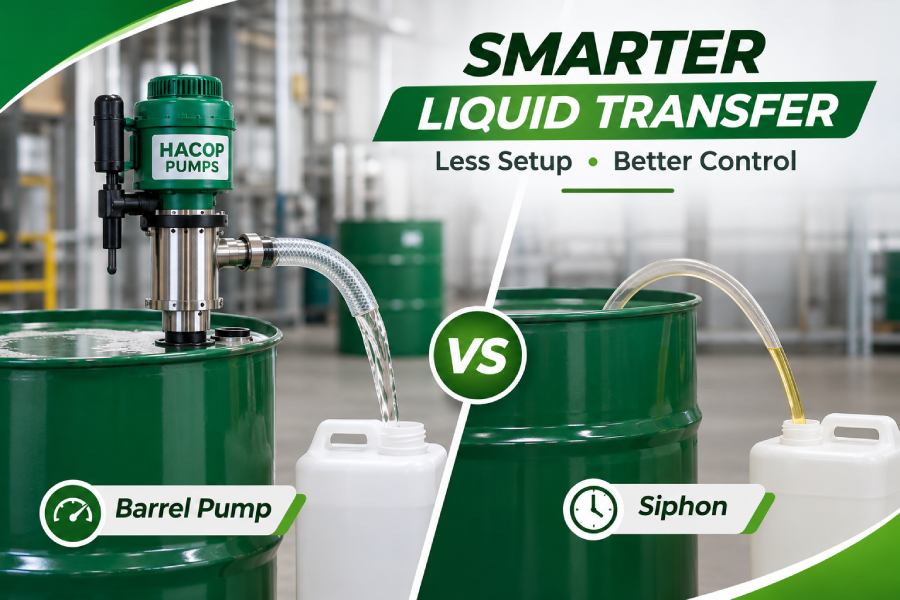
Two commonly used options are barrel pumps and siphons. Both can move liquids between containers, but they work differently and offer different levels of convenience, control, and safety.
So, which method actually saves more time?
Let’s compare both options, understand their practical advantages, and identify where each method makes the most sense.
What Is a Barrel Pump?
A barrel pump is a liquid transfer device designed to extract fluids directly from drums, barrels, and similar containers.
Depending on the application, barrel pumps can operate manually, electrically, or pneumatically.
How Does a Barrel Pump Work?
Most barrel pumps use a suction tube inserted into the container. The pump creates the necessary pressure or mechanical action to move liquid through the discharge outlet.
The transferred liquid can then be directed into another container, tank, processing equipment, or dispensing system.
Common Applications
Barrel pumps are frequently used for
- Transferring oils, lubricants, and industrial fluids.
- Handling compatible chemicals.
- Dispensing cleaning solutions.
- Moving liquids from storage drums into smaller containers.
- Supporting production and maintenance operations.
Why Businesses Use Barrel Pumps
A properly selected barrel pump can offer
- Faster liquid transfer compared with manual siphoning.
- Better control over dispensing.
- Reduced dependence on manual handling.
- Convenient operation for repeated transfers.
- Improved consistency during routine liquid handling.
The right pump depends on the liquid’s viscosity, chemical compatibility, required flow rate, and operating environment.
What Is a Siphon?
A siphon is a simple liquid transfer arrangement that uses gravity and pressure differences to move fluid from one container to another.
It typically consists of a tube or hose connecting two containers positioned at different elevations.
How Does a Siphon Work?
A siphon generally requires:
- A liquid-filled or primed tube.
- A source container positioned higher than the receiving container.
- A suitable height difference between the liquid levels.
- A continuous flow path without air interruptions.
Once the siphon starts, gravity helps maintain the flow as long as the conditions required for siphoning remain satisfied.
Common Applications
Siphons are commonly used for
- Transferring water between containers.
- Draining tanks in suitable setups.
- Moving compatible liquids in basic applications.
- Occasional liquid transfers where equipment availability is limited.
Limitations of Siphons
Although siphons are inexpensive and simple, they can introduce operational challenges
- Priming may require additional time.
- Flow depends on elevation differences.
- Flow rate can be difficult to regulate.
- Some setups require awkward positioning of containers.
- Improper priming can interrupt the transfer process.
For industrial applications, these limitations may become more noticeable when liquids need to be transferred frequently.
Barrel Pump vs Siphon: Key Differences
The following comparison highlights the practical differences between these two liquid transfer methods.
| Feature | Barrel Pump | Siphon |
|---|---|---|
| Operating method | Manual, electric, or pneumatic | Gravity and pressure difference |
| Starting the transfer | Pump operation | Priming required |
| Flow control | Generally better control | Limited control |
| Transfer speed | Depends on pump capacity | Depends on elevation and hose conditions |
| Repeated operations | Convenient | Can become time-consuming |
| Container positioning | Generally flexible | Requires suitable elevation |
| Operator effort | Depends on pump type | Priming and positioning effort |
| Spill management | Controlled setup can reduce spills | Improper priming may cause spills |
| Industrial suitability | Suitable for many routine applications | More suitable for simple transfers |
The actual performance of either method depends on the liquid, equipment design, transfer distance, and operating conditions.
Which Liquid Transfer Method Saves More Time?
For most repeated industrial liquid transfer operations, a barrel pump saves more time than a conventional siphon.
The main reason is not just transfer speed. It is the reduction in preparation, handling, and interruption time.
1. Faster Setup for Repeated Transfers
A barrel pump can be inserted into a compatible drum and operated without arranging an entire siphon setup.
With a siphon, the operator may need to:
- Position the source and receiving containers.
- Prime the tube.
- Establish the required elevation difference.
- Check whether the liquid is flowing properly.
These additional steps can add up when multiple drums are handled throughout the day.
2. Less Dependence on Gravity
Siphons rely on gravity and the relative height of the containers. Barrel pumps provide mechanical assistance, making them more practical in situations where container positioning is restricted.
This can be especially useful in crowded workshops or production areas.
3. Better Control During Dispensing
Many barrel pumps offer more predictable dispensing than a basic siphon arrangement. Depending on the pump design, operators can start, stop, and direct the transfer more conveniently.
This helps when liquids need to be transferred into smaller containers or measured quantities.
4. Reduced Time Spent on Repeated Manual Tasks
In facilities where liquids are transferred several times a day, the time saved during each operation can accumulate.
For example, consider a workplace transferring liquid from 10 drums daily.
If a pump reduces the combined setup and handling time by 2 minutes per drum, the total time saved would be:
- 2 minutes per drum.
- 10 drums per day.
- 20 minutes saved daily.
- Approximately 100 minutes saved over five working days.
This is an illustrative calculation, not a guaranteed performance figure. Actual savings depend on the equipment, operator experience, and transfer conditions.
5. Improved Workflow Consistency
Barrel pumps can make routine transfer activities easier to standardize. Operators can follow a consistent process instead of repeatedly adjusting hose positions and priming arrangements.
For production environments, this consistency can improve workflow planning and reduce avoidable interruptions.
Advantages and Limitations
Both methods have their place. The right choice depends on how frequently liquids are transferred and the conditions under which the operation takes place.
Barrel Pump: Pros and Cons
Advantages
- Suitable for frequent liquid transfer.
- Convenient operation for routine dispensing.
- Better control over liquid movement.
- Available in different operating configurations.
- Can reduce manual handling and preparation time.
Limitations
- Initial equipment investment.
- Requires maintenance and proper cleaning.
- Pump materials must match the liquid.
- Electrical or pneumatic models may require supporting infrastructure.
Siphon: Pros and Cons
Advantages
- Simple construction.
- Low initial cost.
- No powered equipment required.
- Suitable for occasional transfers under appropriate conditions.
Limitations
- Priming may take time.
- Requires suitable elevation differences.
- Flow control is generally limited.
- Not ideal for frequent industrial dispensing.
- Improper handling can increase spill risks.
How to Choose the Right Transfer Method
Before selecting a liquid transfer solution, consider these practical factors.
1. Frequency of Liquid Transfer
- Occasional transfer: A siphon may be sufficient for suitable liquids and setups.
- Daily transfer: A barrel pump can improve convenience.
- Frequent production transfers: Consider an appropriately sized industrial pump.
2. Type of Liquid
Different liquids require different pump materials and designs.
Check
- Chemical compatibility.
- Viscosity.
- Temperature.
- Corrosive properties.
- Flammability and other safety requirements.
Never assume that a pump suitable for water can safely handle industrial chemicals.
3. Required Transfer Speed
If speed is important, compare the actual flow rate of the equipment rather than relying only on product descriptions.
A pump’s performance depends on
- Liquid viscosity.
- Tube diameter.
- Discharge height.
- Pump construction.
- Operating conditions.
4. Operator Safety
Liquid handling should minimize unnecessary contact, splashing, and exposure.
For hazardous liquids, use appropriate equipment, compatible connections, personal protective equipment, and safe operating procedures.
A siphon should never be started by mouth when handling industrial liquids.
5. Long-Term Operating Cost
Consider more than the initial purchase price.
Evaluate
- Operator time.
- Maintenance requirements.
- Cleaning procedures.
- Equipment lifespan.
- Spill prevention.
- Productivity during repeated operations.
A suitable pump may offer better overall value when transfer activities are frequent.
FAQ’s
Conclusion
When comparing a barrel pump vs siphon, the biggest difference lies in operational convenience and the time required to complete repeated liquid transfer tasks. A siphon remains a practical option for occasional transfers involving suitable liquids and container arrangements. However, a barrel pump generally offers better convenience, control, and workflow efficiency in industrial environments.
For businesses handling oils, chemicals, lubricants, or other compatible liquids regularly, selecting the right pumping solution can simplify everyday operations and reduce unnecessary handling time.
At Hacop Pumps, choosing the right liquid transfer equipment starts with understanding your application, operating requirements, and safety considerations.